Here on Three Cheers, I talk a lot about privilege, without really explaining what privilege is.
It’s a word that we’ve all heard, probably since we were children. My brother and I would lose our TV privilege when we were younger if we got in trouble. Privilege now often relates to someones class, race, and other factors. It’s called a privilege because it gives them an advantage in life.
For instance, male privilege is something often talked about in feminist circles, and is exactly what it sounds like: the privilege that comes from identifying as male (Note: People who are designated male at birth (or DMAB) do not necessarily experience male privilege. Trans women are women, and the privilege is not extended to them. Similarly, trans men may experience male privilege). Male privileges include being taken more seriously in workplaces, not having to fear sexual harassment, male characters tend to be well-rounded and interesting, less likely to be the butt of a joke, and others of varying degrees of obviousness.
White privilege is another that gets a lot of attention. The privileges that come from being visibly white include being more likely to be hired, less likely to be shot on the street, generally assumed to be more trustworthy, and not being questioned when taking pieces of cultures you know nothing about into your life for the aesthetic.
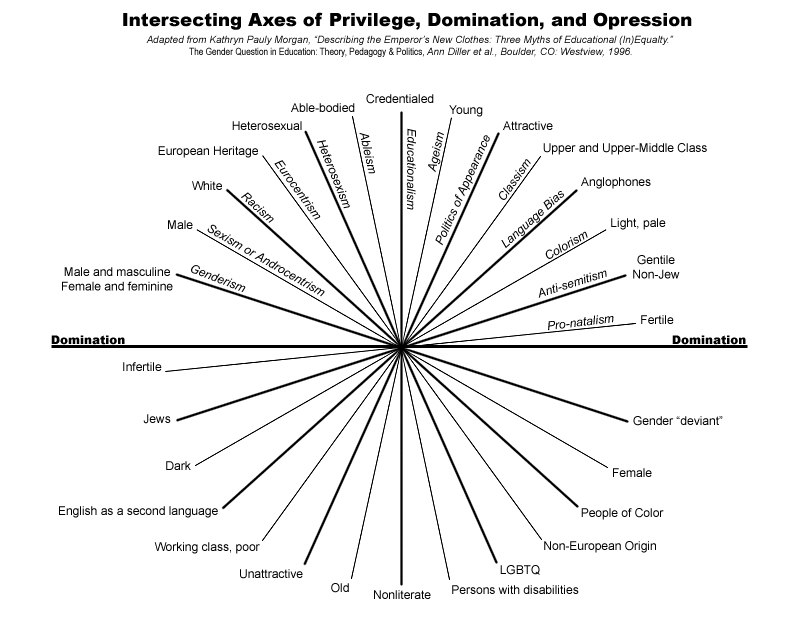
Other privileges include being thin, able-bodied, neurotypical, straight, cisgender, English-speaking, conventionally attractive, upper class, and many, many others. All of these privileges have oppressed counterparts that involve stigma, stereotyping, erasure, harassment, and microagressions, as well as more severe actions, up to murder and rape.
Having a privilege means benefiting from systematic oppression. Even if a person does not actively oppress others and checks themselves, being in a position of privilege gives an advantage no matter what. What one does with that privilege matters.
All these privileges overlap with each other often. A person can be gay and black, but also cisgender and DMAB. This intersectionality of privilege and oppression is kyriarchy. Kyriarchy dictates that a person who is privileged in one way may be oppressed in another. If a person is straight, cisgender, DMAB, white, able-bodied, neurotypical, thin, attractive, native English speaker, they would be very privileged. A bisexual trans woman of color who is disabled, neuroatypical or neurodivergent, overwieght or otherwise conventionally unattractive, would be very oppressed.
People who are privileged tend to want to keep their privilege and not have to face any backlash that may come from it. White people often don’t like to hear about racism, men will trivialize the experiences of women, thin people are only looking out for fat people’s “health”, and straight parents may tell their children that they are too young to label their sexuality. These are common microaggressions.
Privileged people, when faced with those whose oppression they benefit from, get very offended to they are generalized into a group, or when they have to deal with people’s anger. They use common phrases like “hate breeds hate” to keep the oppressed people oppressed, often without knowing that it trivializes and downplays the experiences, and is a microaggression.
Their privilege allows them to do this, and do it without having to think critically about their actions or be questioned. As people become more educated about topics such as privilege, they’re more likely to check themselves and their actions, and call out others for oppressive behavior. This is the key to dismantling the kyriarchy: knowledge and willingness to change.
More on:


Recent Comments